Monday, April 18, 2016

7.3: Partial Fraction Decomposition

Definitions


Previously, we have written rational expressions in the form of:


These expressions can also be written as the sum of two or more rational expressions. For example:


The entire right side is known as the partial fraction decomposition, and each fraction is a partial fraction.

The skill of partial fraction decomposition will be used in calculus.

Process of Decomposition


1. Divide if the rational expression is improper. In other words, if the degree of the numerator is greater than or equal to the degree of the denominator, then divide the expression. Complete the remaining steps with the proper rational expression.

2. Factor the denominator.

3. Separate Factors. The following factor must be written as follows:


4. Check your work by combining the partial fractions or graphing the two expressions.

Examples


1.

Multiply by the lowest common denominator.


Since the left side of the equation has no "x" term, (A + B) = 0. (A - B) corresponds to the constant value of 1.


Solving for A and B results in:


 Substitute A and B into the original expression to solve for the partial fraction decomposition:


2.


3.

Since this rational expression is improper, the numerator must be divided by the denominator. This results in:


Now the proper rational expression can be decomposed as normal.


Other Resources


If you would like extra help, the following links provide explanations and examples.

Videos: 
1. Kahn Academy     
2. Patrick    
3. MIT

Text: 
1.Purple Math     
2. Paul 


Sunday, April 17, 2016

6.2: Law of Cosines

Law of cosines 
In section 6.2 the law of cosines is introduced. The law of cosines can be used when solving for sides and angles of a triangle. There are two cases where the law of cosines can be applied. 
- Side angle side (SAS)
- Side side side (SSS)


Deriving the law of cosines 


This form can be written a total of three ways and would be used when trying to find the opposite side of a known angle (SAS). 

The law of cosines can also be written another way. When using these forms, all side lengths are known (SSS) and an angle is solved for. 

Heron's formula

Heron's formula can be used to find the area of a triangle using its side lengths, where s equals the semi-perimeter. 

Thursday, April 14, 2016

6.1: Law of Sines

6.1: LAW OF SINES

To solve an oblique triangle you MUST have any of the four cases to be solved with law of sines:
  • Two angles and any side (ASA)
  • Two sides and an angle opposite one of them (SSA)
The Ambiguous Case

When given two sides and an angle, you have an ambiguous case. There are three situations of triangles.

  1. Single Solution Case
    • The above triangle is a single solution triangle
    • You can solve for this triangle using the Law of Sines
    • ONE SOLUTION because angle A is acute, and a > b
       2. No Solution Case
    • In the above triangle, angle A is on the left, angle C is on top, and angle B is on the right
    • No triangle can be formed from these dimensions given
      • If you were to drop an altitude, you would find that a < h, which is impossible
       3. Two Solutions Case
    • In the above triangle, angle A is on the left, angle C is on top, and angle B is on the right
    • In this case, with the given dimensions, two triangles can be made
    • This is because (h < a < b)
    • When you solve for angle B, you must solve for both angles that answer sinB
      • subtract the answer you get from 180
      • you will have made two triangles that must be solved, as seen in the right two triangles

Area of an Oblique Triangle 


Wednesday, March 23, 2016

5.5 Multiple-Angle and Product-Sum Formulas

BASIC INFORMATION
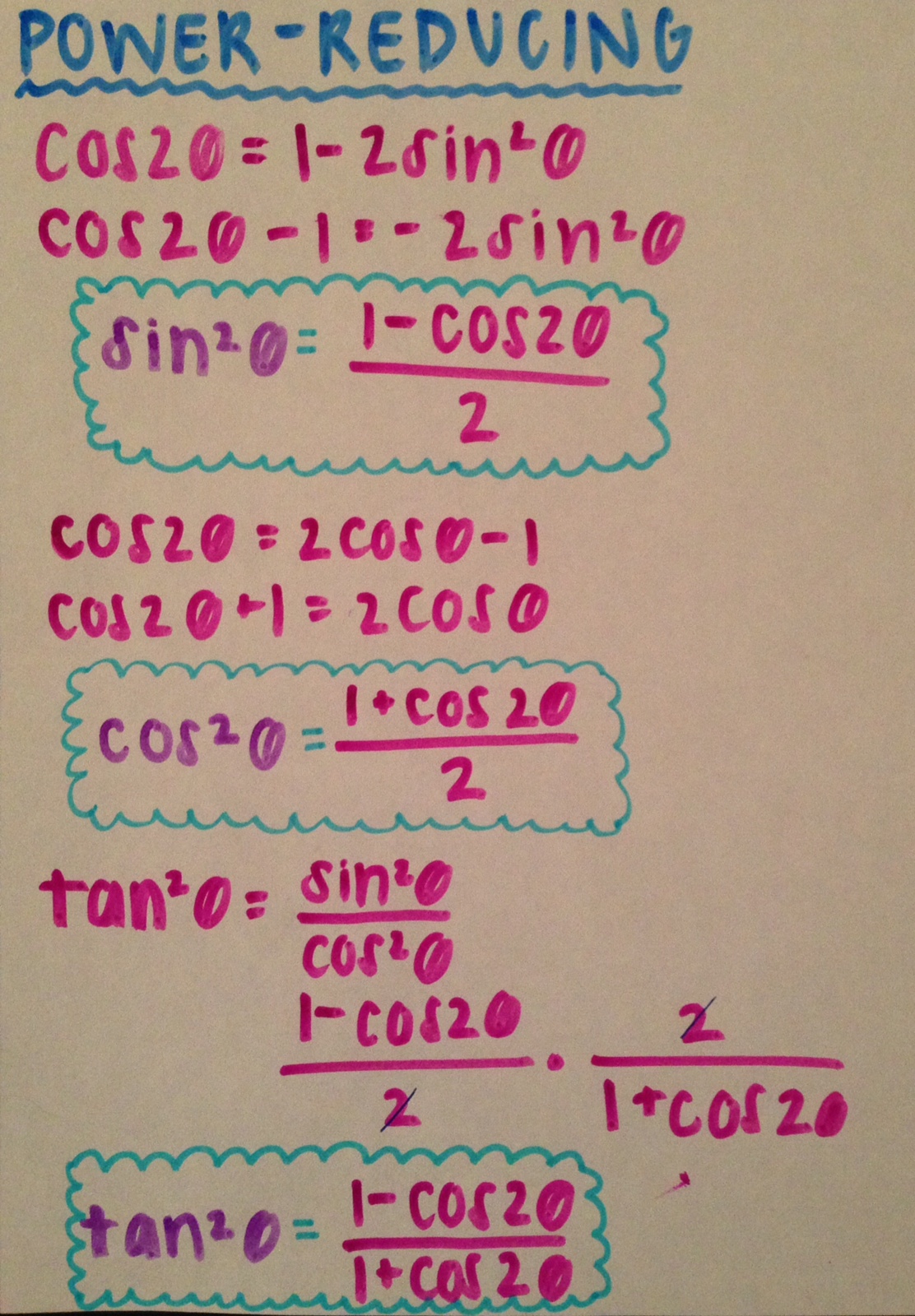
In unit 5.5, we learn the double-angle formulas, the power-reducing formulas, and the half-angle formulas.  We will be given all the formulas except for the double-anglge formulas on the test.  We also need to know how to derive all the formulas for the test.


DOUBLE-ANGLE FORMULAS:


HOW TO DERIVE THE DOUBLE-ANGLE FORMULAS:


POWER-REDUCING FORMULAS:


HOW TO DERIVE THE POWER-REDUCING FORMULAS:


HALF-ANGLE FORMULAS:


HOW TO DERIVE THE HALF-ANGLE FORMULAS:


If any of these don't make sense to you, watch this video on how to derive the formulas:


Visit the sites below for additional help: